Special Research Project on Urban Design for the Shanghai Urban Master Plan (2017-2035)
The System and Measures for Overall Urban Design of Shanghai
01. Project Overview: Redefining Urban Design
As a pivotal special research project supporting the Shanghai Urban Master Plan (2017-2035), this study represented a paradigm shift in Chinese master-scale urban design. Moving beyond the conventional 'engineering' or 'aesthetic' approach, this research redefined the urban environment as a Public Good, positioning urban design as a strategic tool for Public Welfare Governance.
Drawing on Welfare Economics, the study established a rigorous top-level methodological framework that links spatial diagnosis, economic reasoning, and policy zoning. It aimed to correct the structural bias of traditional master plans—which often prioritise 'city image' and aggregate growth—by shifting focus to the distribution of spatial quality, accessibility, and environmental security. This resolved the tension between rapid urbanisation and quality of life by categorising the city into policy zones based on principles of allocative efficiency and distributive justice.
02. Theoretical Framework: The Economics of Space & The Dual-Logic Approach
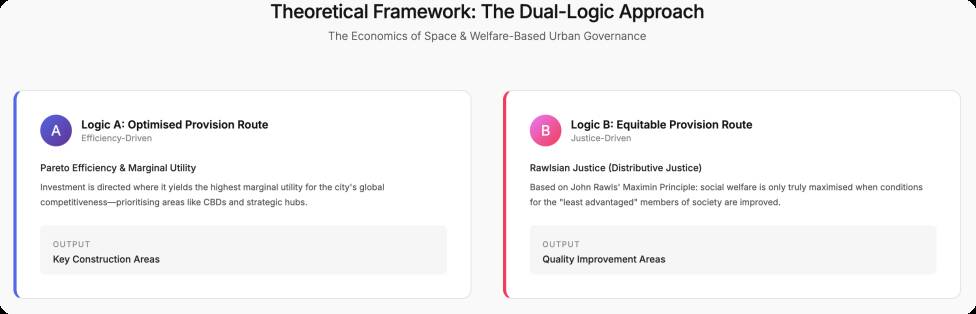
The core innovation of this research was the application of Welfare Economics to urban design governance. We posited that the urban environment functions as a "Welfare Triangle" (State, Market, Individual), where spatial quality is a redistributable asset. The methodology was bifurcated into two economic principles:
-
Logic A: The Optimised Provision Route (Efficiency)
Pareto Efficiency & Marginal Utility: Used to identify 'Key Construction Areas' (e.g., CBDs, Hubs). Investing here yields the highest marginal utility for the city's global competitiveness. -
Logic B: The Equitable Provision Route (Justice)
Rawlsian Justice (Distributive Justice): Used to identify "Quality Improvement Areas." Based on John Rawls' Maximin Principle, this argues that social welfare is only truly maximized when the conditions of the "least advantaged" members of society are improved. This formed the theoretical basis for my specific research focus.
03. Technical Route & Spatial Zoning
- Welfare Definition: Deconstruct 'Urban Spatial Quality' into measurable welfare indicators (environment, accessibility, vulnerability).
- Diagnostic Analysis: Mapped citywide disparities to identify 'Spatial Deprivation' versus 'High Potential.'
- Economic Application: Apply Rawlsian Justice (Equity) and Marginal Utility (Efficiency) to categorise the territory.
Shanghai Urban Master Plan Policy Framework
Spatial Policy Zoning & Construction Control Guidance System
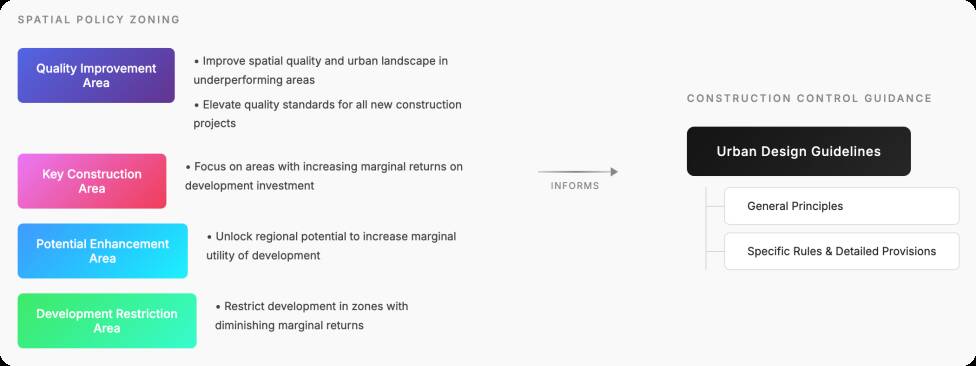
Spatial Zoning: Instead of a static physical blueprint, the research proposed a dynamic policy zoning system. We classified the entire administrative area of Shanghai (approx. 3,000 km²) into four distinct governance zones:
- Quality Improvement Area: Focused on equity and baseline guarantees (my focus).
- Key Construction Area: Focused on efficiency and global image.
- Potential Elevation Area: Focused on stock regeneration and endogenous growth.
- Development Restriction Area: Focused on ecological protection and negative externalities control.
Policy Formulation: Developed differentiated guidelines, shifting from rigid morphological controls to performance-based urban design criteria.
04. Focal Research: Quality Improvement Area (My Responsibility)
Lead Researcher for 'Equity-Oriented' Spatial Policy: Operationalising Distributive Justice in Spatial Planning
My primary responsibility was to translate the abstract principle of 'Social Equity' into actionable spatial policies for Shanghai's most vulnerable regions. This involved diagnostic research, typology classification, and policy formulation—specifically, defining and developing strategies for Quality Improvement Areas. This category encompassed regions where the 'Happiness Index' and spatial quality lagged behind economic growth, particularly underdeveloped suburbs and aging inner-city neighbourhoods.
Spatial Diagnosis: Identifying Structural Deprivation
Defining 'Quality Improvement Areas' not by aesthetic value, but by deficit in spatial welfare—translating social equity into actionable spatial policy
A. Spatial Diagnosis: Identifying Structural Deprivation
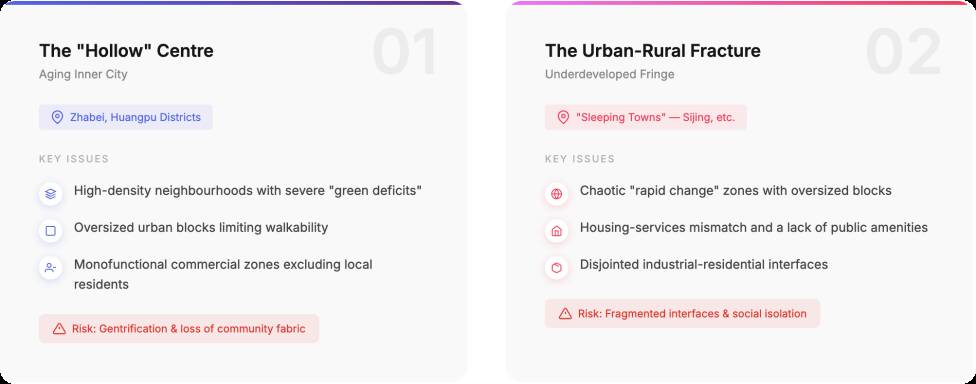
Through quantitative and qualitative analysis, I identified "Quality Improvement Areas" not by their aesthetic value, but by their deficit in spatial welfare. This analysis revealed two critical typologies of spatial deprivation:
- The 'Hollow' Centre (Aging Inner City): High-density neighbourhoods (e.g., Zhabei, Huangpu) suffering from green deficits, oversized blocks, and monofunctional commercial zones that exclude local residents, thereby risking gentrification and loss of community fabric.
- The Urban-Rural Fracture (Underdeveloped Fringe): Chaotic 'rapid change' zones (e.g., 'Sleeping Towns' like Sijing) characterised by oversized blocks, a lack of public amenities, and disjointed interfaces between industrial and residential land. These areas face a mismatch between housing supply and public services, resulting in limited employment opportunities and inadequate social spaces.
B. Strategic Interventions: A Policy Toolkit for Equity
To address these disparities, I developed a 'Fair Supply' strategy to bridge the spatial welfare gap, extending beyond physical design into governance and fiscal policy:

-
Governance Innovation: The 'Community Planner' System
Critiquing the limits of top-down master planning for micro-regeneration, I proposed the institutionalisation of a 'Community Planner' role (referencing the Taipei model). This mechanism empowers local professionals to act as intermediaries between government and residents, facilitating bottom-up regeneration. It creates a localised governance layer that supports participation and ensures design interventions respond to actual resident needs. -
Public Goods Equalisation & Transit Welfare
I advocated a 'transit-as-welfare' approach, prioritising the development of 'last-mile' slow-traffic systems (walking and cycling networks) in suburban areas to connect isolated low-income communities with the rail network, thereby improving their access to the city's economic opportunities. -
Morphological Repair: From 'Super-blocks' to Human Scale
For the oversized grids of the urban fringe, I developed guidelines for block fragmentation. This strategy enforces functional mixing to prevent social segregation and breaks down large, hostile scales into walkable, human-centred neighbourhoods. -
Fiscal Policy Recommendations
Acknowledging that these areas lack market appeal for private capital, the research argued for targeted fiscal transfers. We proposed that government investment should not only pursue efficiency (ROI) but must also be directed to these 'low-yield' areas to guarantee the baseline dignity of the living environment as a fundamental right.
05. Contribution & Impact
The findings of this research were directly integrated into the Shanghai Master Plan (2017–2035). The project successfully argued that for a global city, the 'floor' of spatial quality (the condition of its most vulnerable areas) is just as critical as its 'ceiling' (its skyline and landmarks). The 'Quality Improvement' concept helped elevate urban design from a purely technical tool to a public policy instrument, ensuring that Shanghai's ambition to become a 'Global City' is grounded in inclusivity, equity, and human-centric development.