Yangpu Waterfront Regeneration
Technological Innovation Forest
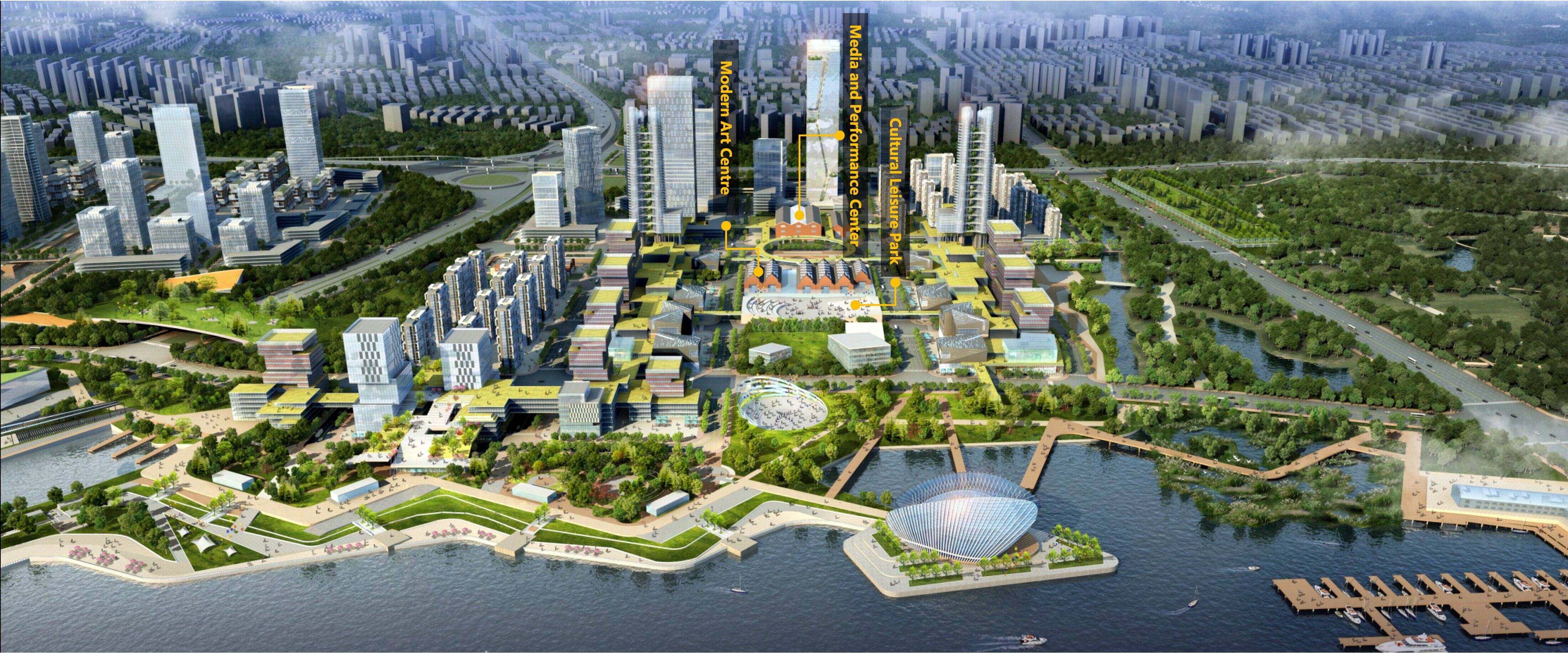
Aerial View of Yangpu Waterfront Regeneration
Project Background & Vision
From "Industrial Rust Belt" to "Technological Innovation Forest" — This project focuses on the regeneration of the Yangpu North-Central Waterfront, transforming a formerly enclosed, mono-functional industrial corridor into an open, ecological, and socially inclusive urban waterfront.
Rather than treating the riverfront as a mere scenic edge, the design reconceptualizes it as a "Productive Urban Landscape". The vision, titled "Technological Innovation Forest," establishes a hybrid system where innovation-oriented industries, historic industrial structures, blue-green infrastructure, and everyday public life coexist and reinforce one another.
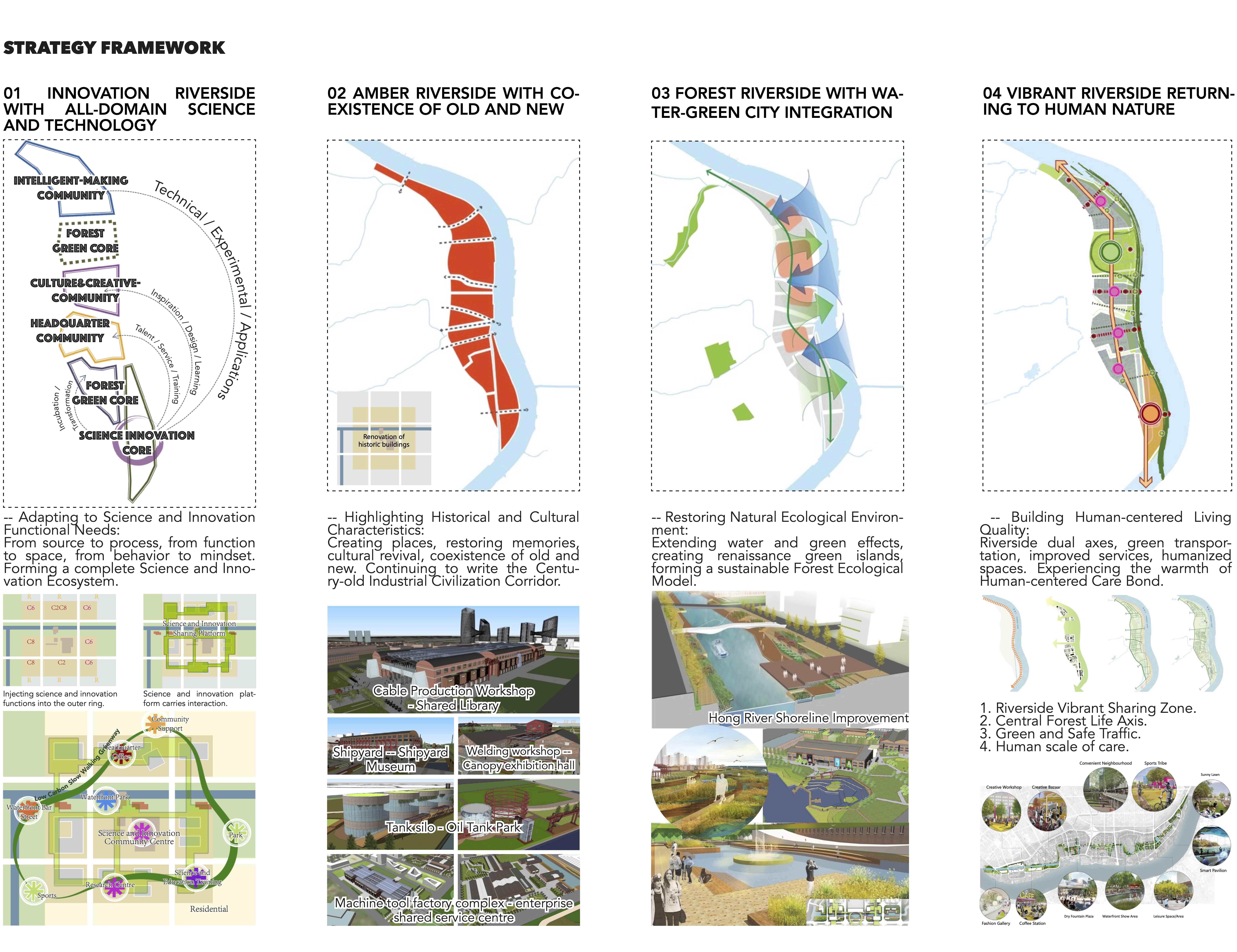
Strategy Framework: Four Key Design Strategies
Key Design Strategies
01. Innovation Riverside with All-Domain Science and Technology
Adapting to Science and Innovation functional needs: from source to process, from function to space, from behavior to mindset. Forming a complete Science and Innovation Ecosystem.
02. Amber Riverside with Co-existence of Old and New
Highlighting historical and cultural characteristics: creating places, restoring memories, cultural revival, coexistence of old and new. Continuing to write the Century-old Industrial Civilization Corridor.
03. Forest Riverside with Water-Green City Integration
Restoring natural ecological environment: extending water and green effects, creating renaissance, green islands, forming a sustainable Forest Ecological Model.
04. Vibrant Riverside Returning to Human Nature
Building human-centered living quality: riverside dual pass, green transportation, improved services, humanized spaces. Experiencing the warmth of Human-centered Care.
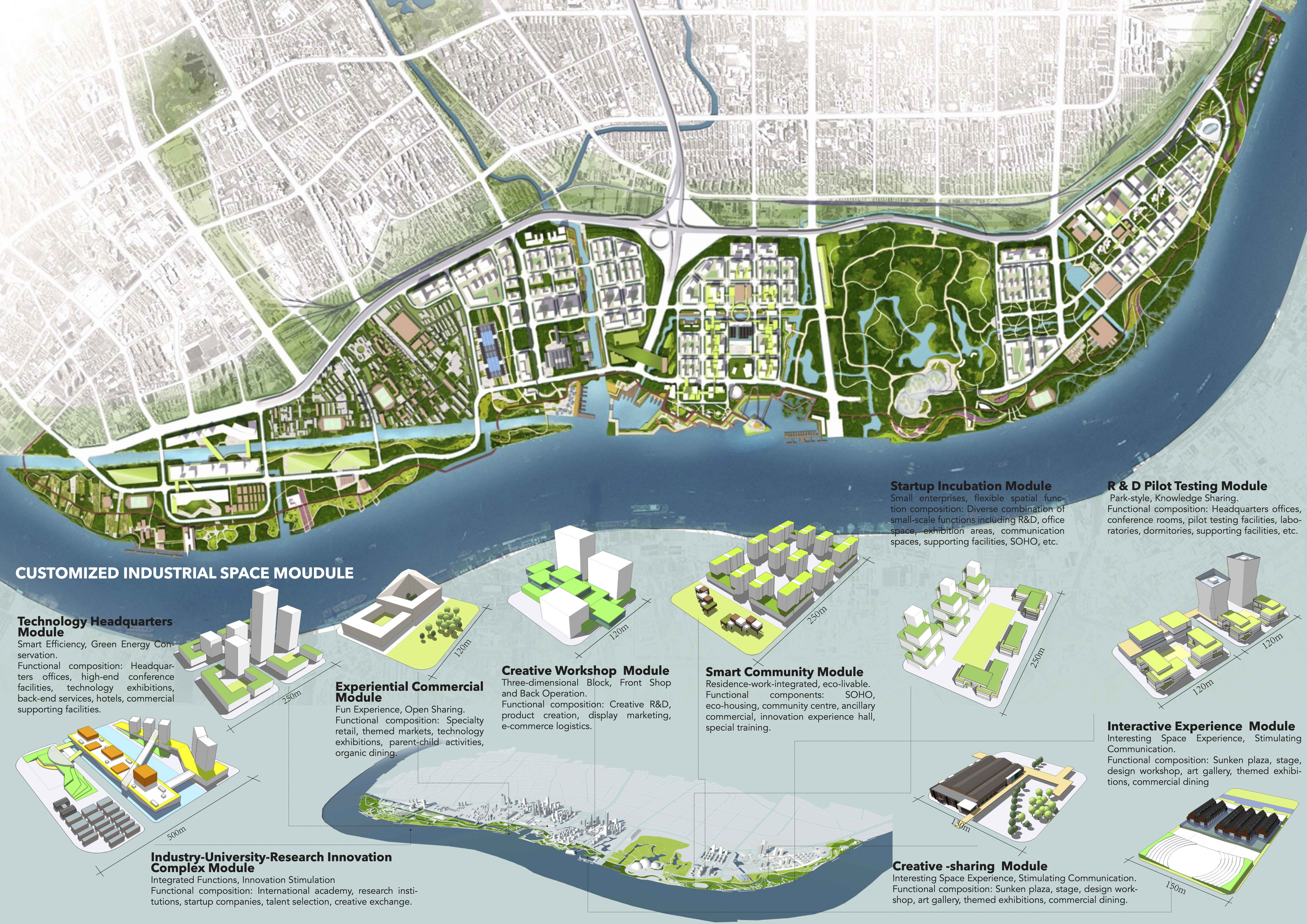
Master Plan and Customized Industrial Space Module
01. Spatial Strategy: A Continuous Ecological-Innovation Spine
At the territorial scale, the project restructures the waterfront into a continuous spine that links major urban anchors. The design establishes urban permeability by breaking former industrial barriers to reconnect the urban hinterland with the river, linking universities and research institutions to the waterfront.
A multi-layered network is established, integrating riverside promenades, internal green corridors, and neighborhood-scale open spaces, shifting the waterfront from a passive edge to an active urban interface.
Urban Generation Process
02. Heritage Activation: Memory as Spatial Infrastructure
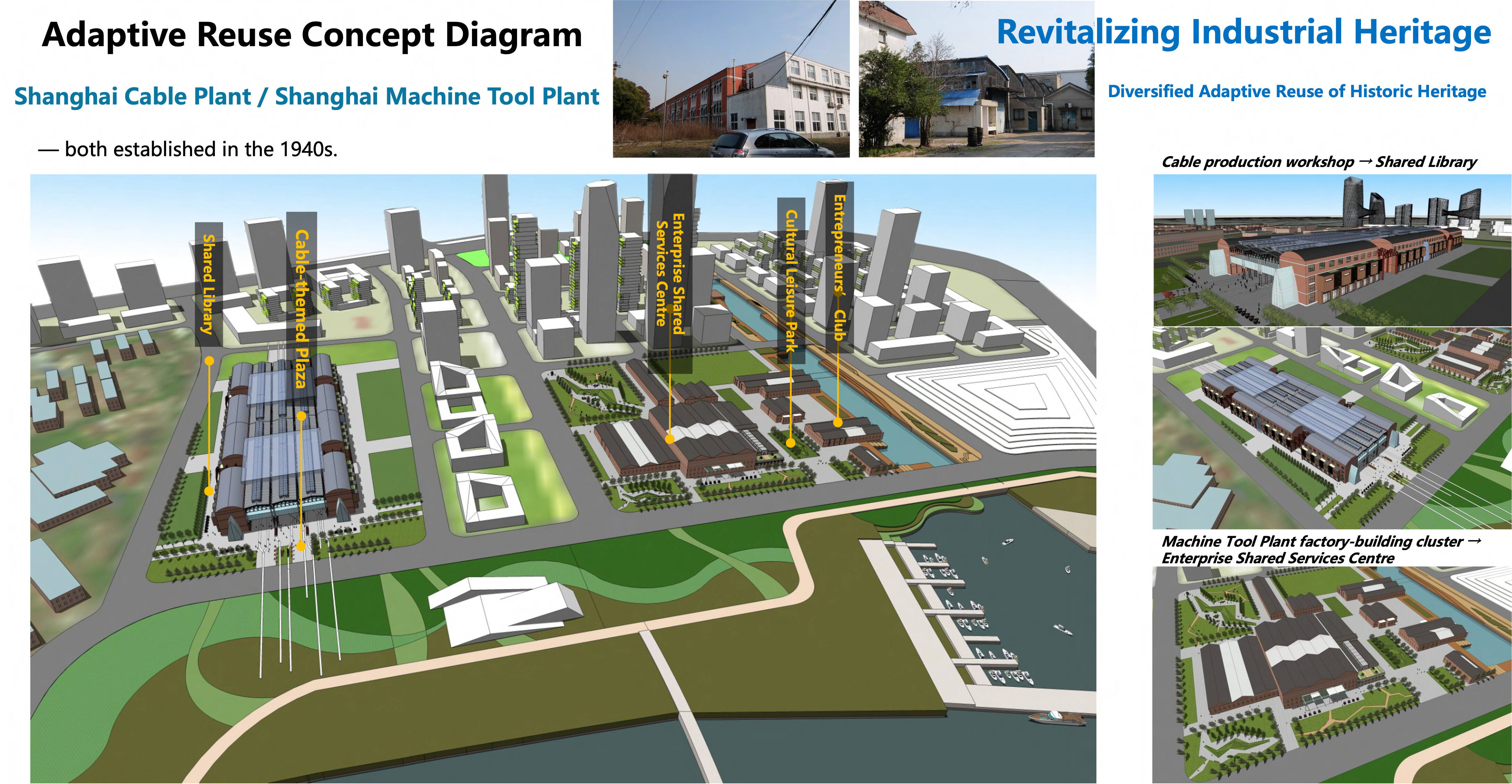
The project adopts a strategy of "Reuse through Activation" for the site's century-old industrial legacy, avoiding static preservation. Large-scale structures such as the Shanghai Cable Plant and Shanghai Machine Tool Plant (both established in the 1940s) are transformed into innovation workspaces, shared libraries, and exhibition halls.
Historic buildings are treated not as isolated monuments but as accessible infrastructure integrated into the open-space system, allowing heritage to be experienced through everyday movement. Key adaptive reuse projects include:
- Cable Production Workshop → Shared Library
- Machine Tool Factory Complex → Enterprise Shared Services Center
- Shipyard → Shipyard Museum
- Welding Workshop → Canopy Exhibition Hall
- Tank Silo → Oil Tank Park
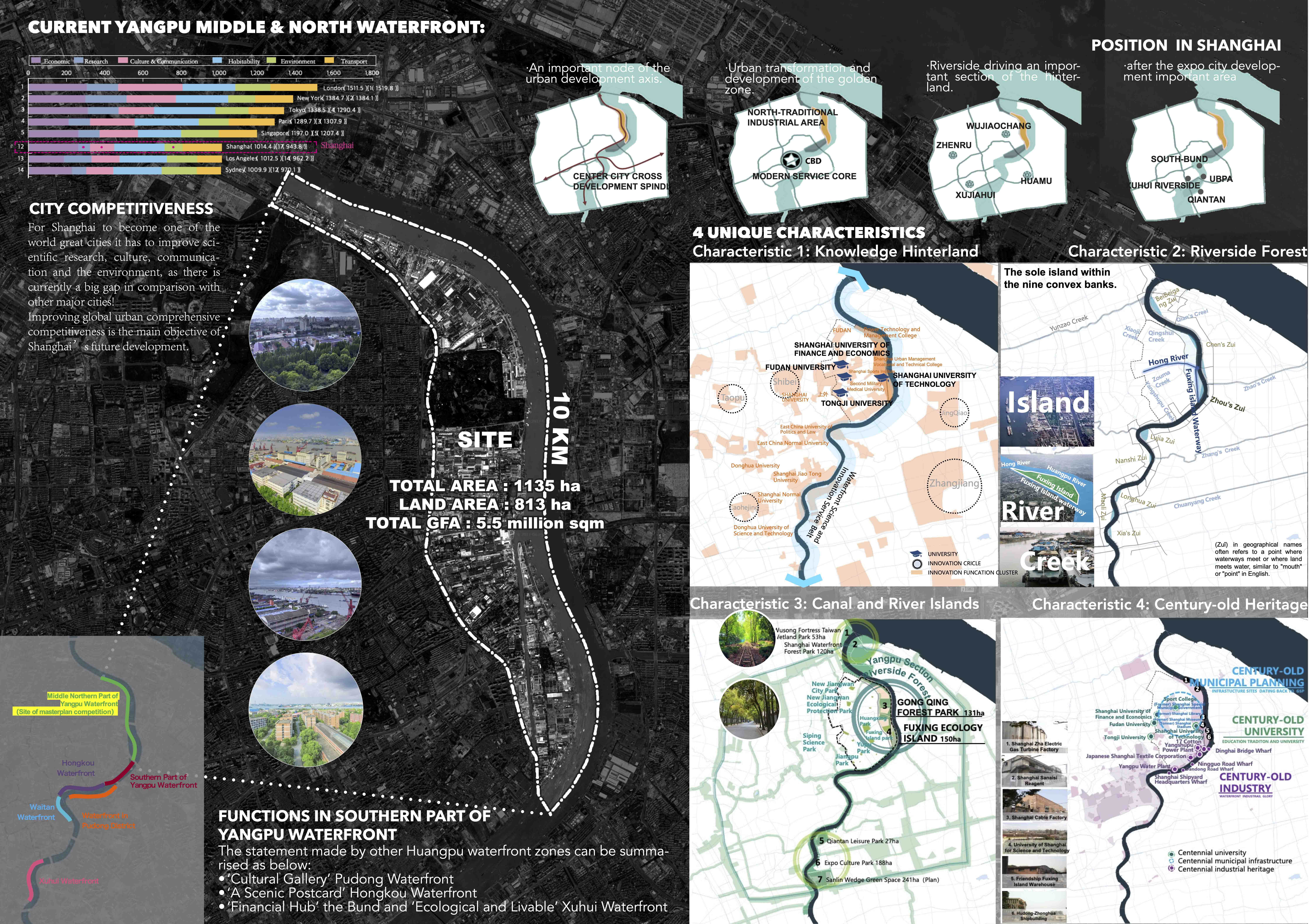
Industrial Heritage Adaptive Reuse Diagram
03. Resilient Landscape: Blue-Green Sponge System
Beyond aesthetics, blue-green infrastructure serves as the ecological backbone of the waterfront. The Sponge City Strategy integrates rainwater retention and infiltration zones directly into public spaces. The hydrological design creates inhabitable landscapes that adapt to seasonal water-level fluctuations, combining flood resilience with recreational value.

Resilient Landscape and Blue-Green Sponge System
04. Key Node Design
Creative Garden Bay: A cultural anchor where the Media & Performance Center and Modern Art Centre merge with renovated industrial heritage, connected by a multi-level "Fashion Cloud Deck".
Smart Forest Island: An ecological innovation hub integrating sports competition centers, knowledge complexes, and wetland parks, embedded within a dense green framework. Key facilities include the Sports Competition Center, Knowledge Complex (Shanghai Innovation Center), Innovation and Technology Institute, Achievement Exchange and Exhibition Center, and Zhonghua Shipyard Heritage Park.
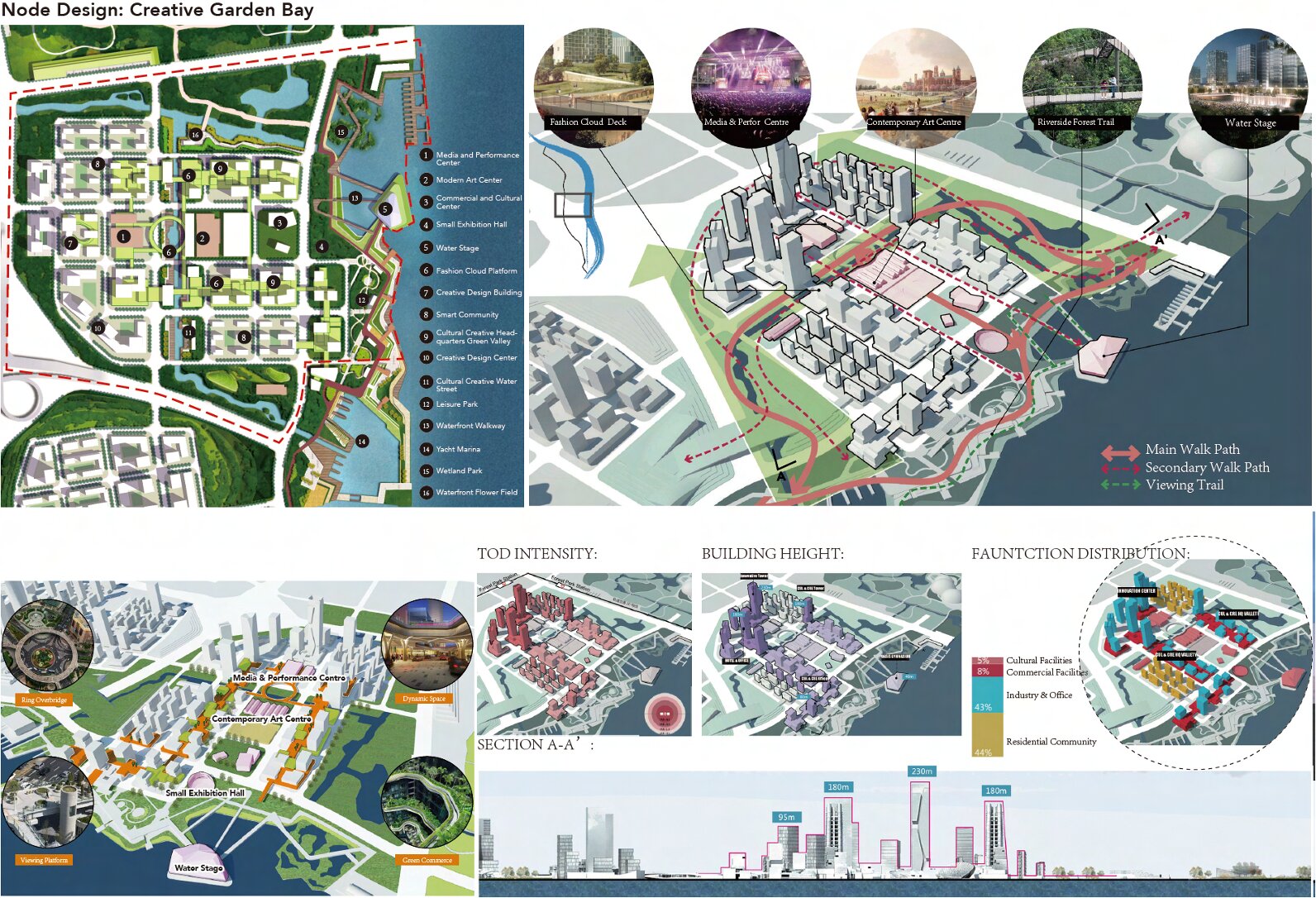
Node Design: Creative Garden Bay
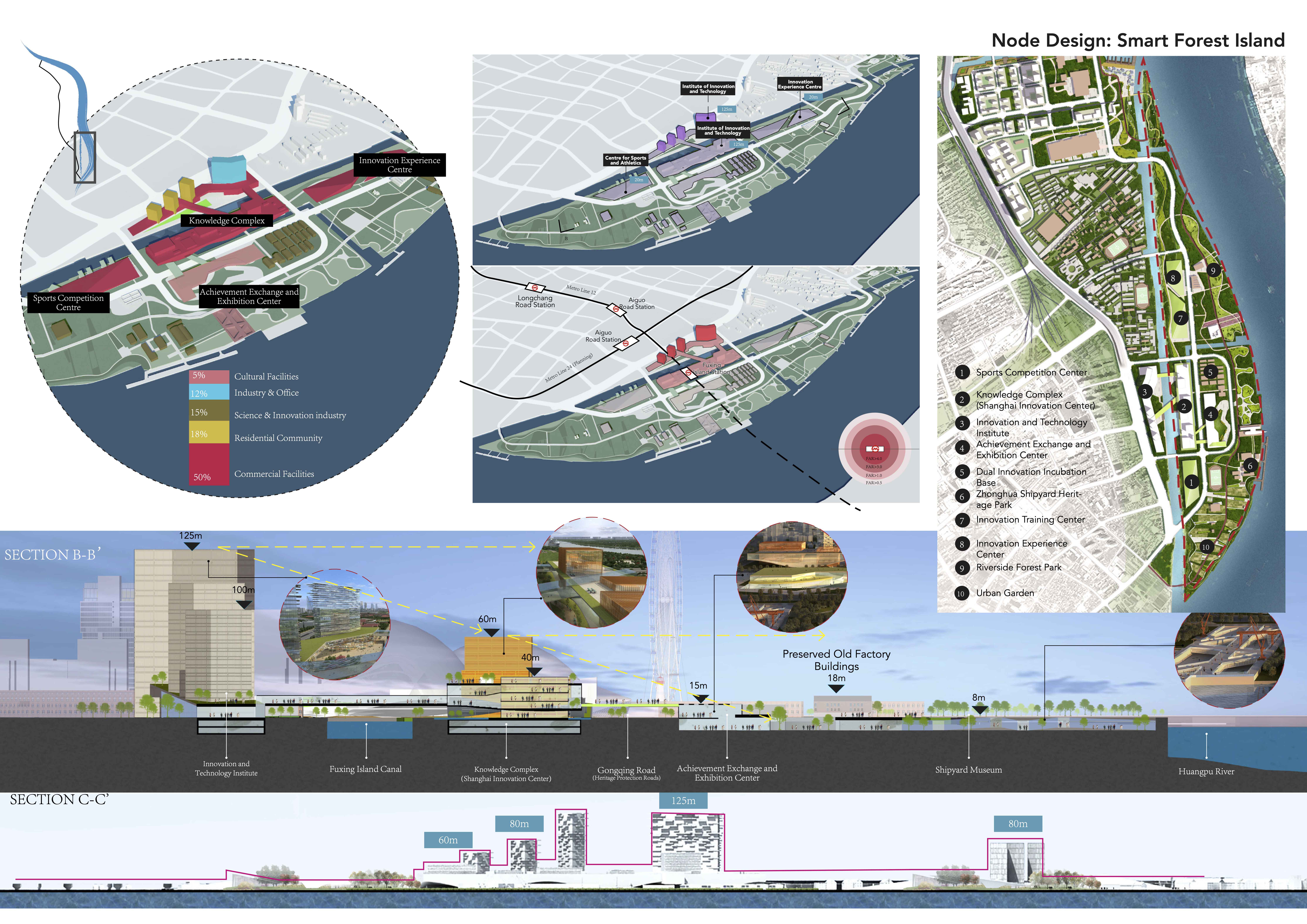
Node Design: Smart Forest Island
Project Contribution
The Yangpu Waterfront project demonstrates how post-industrial urban areas can be transformed into innovation-driven, ecologically resilient, and socially open environments, without erasing historical identity.
By combining spatial strategy, industrial heritage reuse, landscape and hydrological design, the project offers a holistic model for large-scale waterfront regeneration in high-density cities.